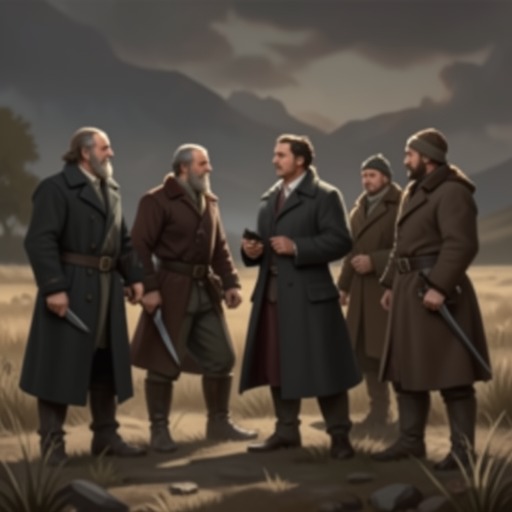
Prentisstown’s murder-defined male adulthood
The Knife of Never Letting GoPrentisstown’s murder-defined male adulthood is a status imposed on boys through a killing, not a simple recognition of age. At thirteen, a boy is made to kill a man on his own while the town’s men watch. The rite converts a boy into an adult by binding him to violence and to the community that requires it; the Mayor’s aim is to make every boy complicit in Prentisstown’s crimes and to place the town’s future under his control.
Identity and Construction
In Ben’s account, boys who became men were told the truth, or a version of it, and then made complicit. Todd’s later understanding makes the mechanism specific: manhood depended on killing another man, alone. The killing was not an individual test of courage or a private act. Its required solitude assigned the act to the boy, while the watching men made the wider community part of its enforcement.
The rite therefore defined adulthood through an imposed crime. The boy received the status of a man by committing violence, and the men who had already undergone the same process became witnesses to its repetition. In this system, the boundary between boy and man was deliberately maintained: men who had crossed it did not talk to boys who had not. The separation concealed what awaited the boys while protecting the process by which they would eventually be brought into it.
Origins in Crisis and Blame
The practice belongs to a broader history of social violence. Ben describes years of hardship across New World: failing crops, sickness, and a lack of prosperity. As conditions worsened, a preaching began to blame the Spackle. Blame became a movement and the movement became a war. Humans had guns and the Spackle did not; Ben describes the result as a defeat from which the surviving Spackle learned not to come close to men again.
The violence then turned inward within Prentisstown. Todd states that after the Spackle were killed, the men of Prentisstown killed the town’s women. Ben qualifies that not every man took part, but says many were swayed by Mayor Prentiss and Aaron. Their preaching cast what was hidden as evil, and the killings included men who tried to protect the women. This sequence connects the coming-of-age rite to a community already shaped by scapegoating and organized violence: the boys’ initiation did not stand apart from the town’s crimes, but was designed to carry those crimes forward into another generation.
The Victims and the Rite in Practice
Todd’s realization overturns what he had understood about men who disappeared. Some had not escaped or vanished; they had been selected as victims for boys’ thirteenth birthdays. Mr Royal, Todd’s former schoolteacher, was said to have taken to whisky and shot himself. Todd learns that Seb Mundy killed him on Seb’s birthday, with the other men of Prentisstown watching. The account identifies not only the victim and killer but the public arrangement: Seb acted alone, and the gathered men witnessed his becoming a man.
Another case reveals how the town could manufacture a suitable victim. Mr Gault, whose sheep flock Todd’s family took over after he disappeared two winters earlier, had tried to flee through the swamp. Mayor Prentiss found him and acted under what Todd describes as New World law. Rather than execute Mr Gault at once, the Mayor waited until Mr Prentiss Jr’s thirteenth birthday and had his son torture Mr Gault to death without anyone else’s help. The delay made the killing serve the birthday rite; the victim’s attempted escape became material for the next boy’s initiation.
The supply of victims was not limited to captured escapees. Todd understands that if the Mayor’s men had no escapee hidden away for a boy’s thirteenth birthday, they could take someone from Prentisstown whom they disliked and say that he had disappeared. The cover story obscured the victim’s fate, while the boy’s assigned act and the watching men preserved the rite. Each victim’s life was handed over to a boy to end on his own, making the town’s private resentments and its enforcement of escape rules available to the same system.
The Mayor’s Design and Todd’s Exception
The rite serves the Mayor’s ambition as well as the town’s violent customs. Ben explains that Mayor Prentiss wanted every boy in Prentisstown to become a man according to his definition. If he could make that happen, he could present himself as the creator of the town and as being in complete control. The phrase that if one falls, all fall expresses this logic: the community’s apparent unity is built from shared culpability, not from mutual care.
Todd was the last boy still outside that system. Ben and Cillian had waited in what Ben calls a town-sized prison, trying to keep Todd innocent until he was old enough to get away on his own. But the Mayor was waiting too. Ben tells Todd that he is a symbol: the last innocent boy of Prentisstown. If the Mayor could make him fall, his army would be complete and wholly made according to his design; if Todd did not fall, the Mayor would kill him. Todd’s delayed initiation thus exposes the rite’s political purpose. The Mayor seeks not simply another adult, but the final proof that no boy can remain outside the identity he has imposed.
Complicity and Meaning
When Todd pieces together the disappearances and the birthdays, the distinction between the person who kills and those who watch collapses. He names the pattern: men Todd knew were killed by boys Todd knew, and the watching community was implicated in both. His recognition culminates in the thought that everyone is complicit and guilty except him, followed by his uncertain question about whether he was truly going to be different. That uncertainty matters: even before the Mayor’s demand is resolved, the rite has made innocence feel precarious by treating refusal as a threat to the whole structure.
Prentisstown’s version of manhood is therefore not merely a violent custom but a method of political reproduction. Each birthday turns a boy into a perpetrator, a dead or disappeared man into the occasion, and the watching men into guardians of continuity. Todd’s exception makes the design visible: the Mayor’s authority depends on the claim that every boy can be made into what he calls a man, and the town’s accumulated guilt depends on each new generation being made to participate.